
Steroid Injections at Injury Hub
Corticosteroid injections are a well-established treatment option for a variety of musculoskeletal conditions. They work by delivering a powerful anti-inflammatory medication directly to the site of pain, helping to reduce swelling, alleviate discomfort, and improve mobility. The effects can be particularly beneficial in managing conditions where inflammation is a primary driver of pain and restricted movement.
Please read this information before your appointment
This leaflet explains what an ultrasound-guided corticosteroid injection involves, why you may be offered one, the possible benefits and risks, and what you should do after your injection.
Our service provides ultrasound-guided injections for joints, bursae and tendon-related problems. We do not perform injections into the spine or around nerves.
Your practitioner will medically assess you to ensure the injection is safe for you. You will have the opportunity to ask questions to your practitioner prior to injection.
WHAT IS AN ULTRASOUND-GUIDED INJECTION?
An ultrasound-guided injection uses an ultrasound scan to see the tissues underneath your skin. This allows the practitioner to guide a small needle accurately to the area being treated.
Depending on your condition, the injection may be given into or around:
- A joint;
- A bursa (a small fluid-filled sac that helps reduce friction around a joint); or
- A tendon-related structure.
The injection contains a mixture of local anaesthetic and corticosteroid.
WHY MIGHT I BE OFFERED A CORTICOSTEROID INJECTION?
Corticosteroid injections may be recommended when inflammation is thought to be contributing to your pain, swelling or stiffness.
The aims of treatment may include:
- Reducing pain and inflammation;
- Making it easier to take part in physiotherapy and return to your usual activities;
- Helping to diagnose whether a particular joint, bursa or tendon-related structure is causing your symptoms.
A steroid injection is part of a wider treatment plan rather than a cure for the underlying problem. For example, reducing your pain may make it easier for you to exercise and strengthen the affected area.
WHAT BENEFIT CAN I EXPECT?
Response to corticosteroid injections varies between patients.
Some people experience a significant improvement in pain and movement. Others experience temporary improvement, while some people experience little or no benefit.
Corticosteroid may take several days (up to 4 weeks) to have its full anti-inflammatory effect. You may experience instant pain relief from the local anaesthetic used this is often temporary.
It is important to understand that:
- An injection does not guarantee improvement;
- Any benefit may be temporary;
- The amount and duration of benefit vary depending on your specific condition
Your practitioner will discuss what benefit you can reasonably expect in your individual circumstances.
WHAT ARE THE POSSIBLE RISKS AND SIDE EFFECTS?
Most people have an ultrasound-guided steroid injections without serious complications. However, any procedure involving a needle carries some risk.
Temporary increase in pain – common
The area may be sore after the injection.
Your usual pain can sometimes temporarily become worse. This is sometimes called a “steroid flare”.
This usually happens within the first 24–48 hours and settles over the following few days. Occasionally, the pain may be more noticeable and last for up to a week.
This does not necessarily mean that anything has gone wrong and does not reduce the effectiveness of the injection. The tissues can become temporarily irritated before the steroid’s anti-inflammatory effect develops.
Infection – very rare
There is a very small risk of infection following an injection into or around a joint, bursa or tendon-related structure.
Published NHS patient information gives figures of approximately 1 in 10,000 for some ultrasound-guided injections, although the exact risk varies depending on the procedure and injection site.
An infection involving a joint or deeper tissue can be serious if it is not treated promptly.
Seek urgent medical attention if you develop increasing pain, swelling, redness or heat around the injection site, particularly if you also develop a fever or feel unwell.
Bleeding or bruising – uncommon
A small amount of bleeding or bruising where the needle enters the skin can occur. This normally settles without treatment.
The risk may be higher if you take blood-thinning medication.
Please tell your practitioner about any anticoagulant or anti-platelet medication you take.
Do not stop blood-thinning medication unless you have been specifically advised to do so by an appropriate healthcare professional.
Changes to the skin or fatty tissue – uncommon
Steroid can occasionally cause:
- The skin around the injection site to become lighter or darker; or
- Loss of some of the fatty tissue underneath the skin, causing a small indentation or “dimple”.
These changes often improve with time but can occasionally be permanent.
Temporary increase in blood sugar
Corticosteroids can temporarily increase blood sugar levels.
This is particularly important if you have diabetes. You may need to monitor your blood glucose more closely for several days after the injection.
If you have diabetes, follow the monitoring or medication advice given to you by your healthcare professional.
Facial flushing or feeling hot
Some people experience temporary:
- Facial flushing;
- A feeling of warmth; or
- Sweating.
This usually settles without treatment.
You may also feel temporarily light-headed or faint around the time of the procedure.
Allergic reaction – very rare
An allergic reaction can occur to the steroid, local anaesthetic or another substance used during the procedure.
A severe allergic reaction (Anaphylaxis) is very rare but can be life-threatening.
Symptoms can include:
- Difficulty breathing;
- Swelling of the lips, tongue or throat;
- A widespread rash;
- Severe dizziness; or
- Collapse.
Call 999 immediately if you develop symptoms of a severe allergic reaction.
Weakening of tissues
If your injection is for a tendon-related problem, your practitioner will explain where the medication will be placed.
Steroid can weaken tendon tissue, and tendon rupture has been reported following steroid injections.
The risk depends on:
- Which tendon is being treated and the condition of that tendon;
- Where the medication is placed
For this reason, steroid injections are not appropriate for every tendon problem.
To reduce risk of tendon injury you will be advised to avoid heavy or repetitive loading of the tendon for a 3 week period after the injection and then gradually return to activity.
Your practitioner will explain any additional risks and activity restrictions that apply to you.
Other less common side effects
Because a small amount of corticosteroid can enter the bloodstream, some people may experience temporary effects elsewhere in the body. These can include:
- Headache or dizziness
- Difficulty sleeping
- Temporary mood changes, such as feeling more anxious, restless or unusually energetic
- Menstrual changes, including an irregular or delayed period or unexpected vaginal bleeding. These are usually temporary.
- Hiccups, which are very uncommon and usually temporary
- Temporary changes in appetite
- Temporary increase in sweating
- Temporary blurred or altered vision - seek medical advice if this occurs
- Temporary stomach upset or indigestion
These effects are very rare after a single local injection, but the likelihood can be higher with larger doses or repeated steroid treatments.
WHAT SHOULD I DO AFTER MY INJECTION?
For the first 24–48 hours
- Take it easy and avoid activities that aggravate your symptoms.
- Avoid strenuous exercise or heavy/repetitive loading of the treated area unless your practitioner has advised otherwise.
- Gentle movement is usually encouraged, unless you have been given different instructions.
- You may use over-the-counter pain killers if required and safe to do so.
- If the area is sore, a cold pack wrapped in a cloth may help.
After 48 hours
Gradually return to your usual activities as your symptoms allow, unless you have been given specific restrictions.
If your injection was for a tendon-related problem, follow the specific advice given by your practitioner, as you may need to avoid heavy loading for longer before gradually increasing activity.
A temporary increase in pain during the first few days can occur. However, severe or rapidly worsening pain is not something you should ignore. Follow the urgent medical advice below if you are concerned.
WHEN SHOULD I SEEK URGENT MEDICAL HELP?
Seek urgent medical attention if, following your injection, you develop:
- Severe or rapidly worsening pain;
- Increasing swelling;
- Redness or heat around the injection site;
- Fever or chills;
- Feeling significantly unwell;
- Persistent or excessive bleeding;
- Difficulty breathing;
- Swelling of your face, lips, tongue or throat; or
- A widespread rash associated with feeling faint or unwell.
Call 999 immediately if you develop difficulty breathing or swelling of your tongue or throat.
Very rarely, a severe inflammatory reaction can occur after an injection and may look like an infection. This is sometimes called a “pseudo-sepsis” reaction.
Because it can be difficult to distinguish this from a genuine infection, severe or rapidly worsening symptoms require urgent medical assessment.
SIDE EFFECTS THAT MAY OCCUR AFTER THE STEROID INJECTION
- A small amount of bleeding and bruising may occur, which will usually settle without any treatment
- Numbness may occur in the region of symptoms, and may extend down a limb or into the hand/foot
- There may be some pain, heat, redness and swelling for 1-2 days in the region of symptoms. It usually settles with a cool pack and regular painkillers
- If you are a diabetic using insulin, your blood glucose levels may increase for a few days. Contact your diabetic nurse if needed
- Facial flushing and/or a hot flush may occur for 1-2 days after the injection
- An irregular menstrual cycle may occur for a few months
- The skin may go white and/or form a dimple around the injection site (resolves after a few months)
- Headaches (1 in 10 patients)
- Increased blood pressure
- Stomach pain or acid reflux (particularly if you have a stomach ulcer)
- Tendons can be more prone to tears/rupture after steroid injections (see below)
- Weakening of the cartilage in a joint (particularly with repeated injections)
WHAT HAPPENS AFTER THE STEROID INJECTION?
- We advise you not to drive for six hours after an injection
- If you have had local anaesthetic injected, you may not have any pain for the first few hours
- Do the minimum activities necessary for the next 2 days after the injection
- In the first month afterwards, do not put any strain on the area of symptoms while the injection works
- For tendon sheath/bursa injections, you should avoid activity that caused pain (during or after the activity) for at least 1-2 months afterwards
- Physiotherapy follow up is important for advice on when and how to return to activities, and for advice on a rehabilitation/exercise programme (particularly with tendons, which can take 4-6 months to heal).
After 48 hours
Gradually return to your usual activities as your symptoms allow, unless you have been given specific restrictions.
If your injection was for a tendon-related problem, follow the specific advice given by your practitioner, as you may need to avoid heavy loading for longer before gradually increasing activity.
A temporary increase in pain during the first few days can occur. However, severe or rapidly worsening pain is not something you should ignore. Follow the urgent medical advice below if you are concerned.
HOW QUICKLY DOES IT WORK AND HOW LONG DOES IT LAST?
Most people notice an improvement within a few days or a week. However, it may take up to 6 weeks for the steroid to work. The benefit can last for 2-12 months, or for even longer sometimes.
RARE SYMPTOMS THAT REQUIRE AN URGENT GP APPOINTMENT OR VISIT TO THE EMERGENCY DEPARTMENT (A&E)
If you have severe pain, redness and swelling at the site of the injection, or fever persisting for at least 2-3 days after the injection, then this could be infection. Please see your GP urgently or go to A&E.
Allergic reactions are extremely rare, and if they occur soon after the injection at home, look out for redness and swelling of the skin. Please see your GP urgently or go to A&E, particularly if you are having difficulty breathing.
If you feel drowsy, confused, dizzy or euphoric, have tinnitus, blurred or double vision, generalised sensations of heat, cold or numbness, twitching, or tremors at home on the day of the injection, this would also be extremely rare, but could be due to the local anaesthetic injection. You will need to go to A&E.
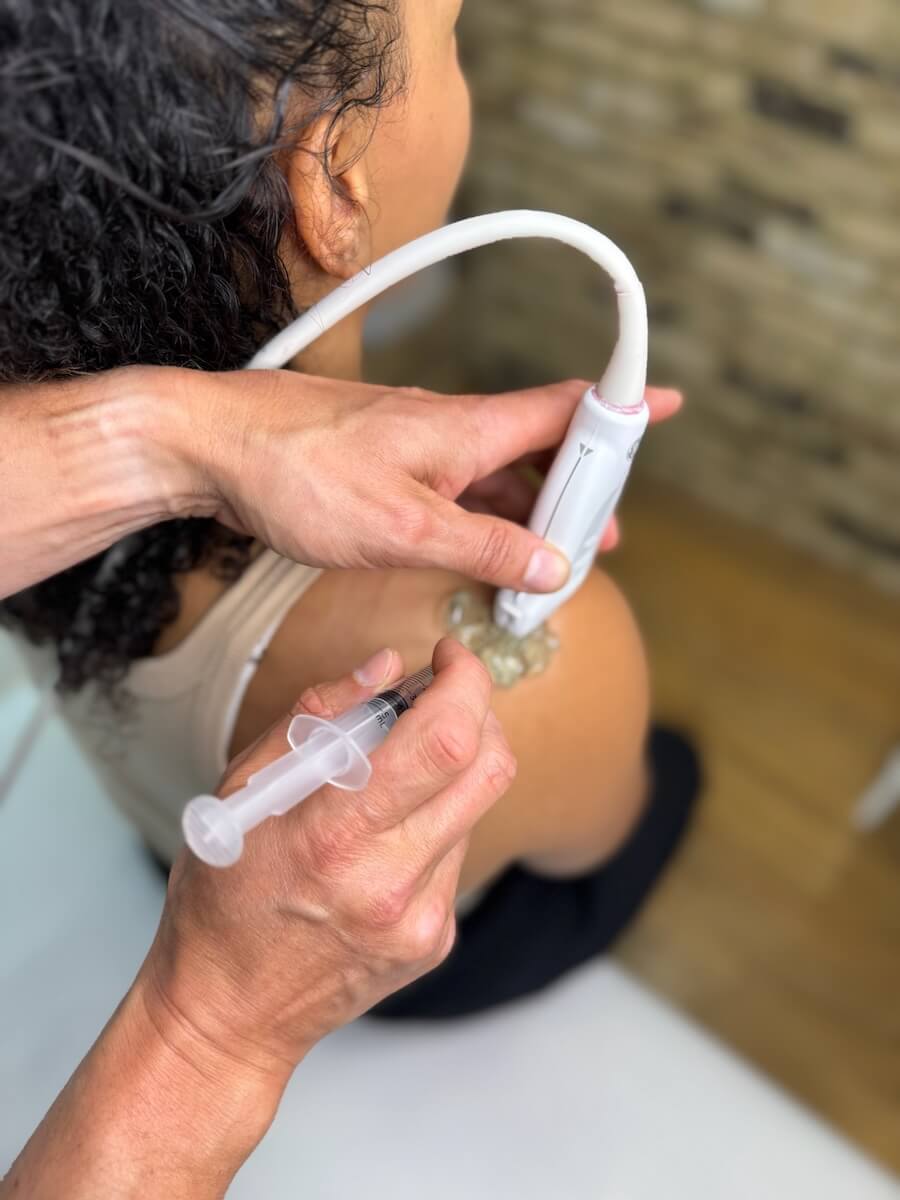
At the Injury Hub, we offer ultrasound-guided steroid injections on-site, typically available within 24 hours, ensuring timely relief for patients in acute distress. Ultrasound guidance allows for precise needle placement, maximising the therapeutic effect while minimising risks and discomfort.
We commonly treat:
- Shoulder bursitis
- Frozen shoulder (adhesive capsulitis)
- Trochanteric bursitis (hip)
- Knee osteoarthritis
- Trigger fingers
- Carpal tunnel syndrome (nerve hydrodissection)
- Elbow pain (e.g., tennis or golfer’s elbow)
- Ankle and foot joint inflammation
For more complex spinal conditions such as sciatica or nerve root irritation, we’re proud to collaborate with Dr. Sajid Butt, a highly regarded Consultant Interventional Radiologist. He performs all of our spinal interventions, including facet joint injections and nerve root blocks, ensuring world-class care for patients with more advanced or nerve-related pain presentations.
When Are Steroid Injections Appropriate?
At the Injury Hub, we are committed to responsible, evidence-based care. While steroid injections can be a highly effective intervention, especially in conditions like frozen shoulder, where they may help halt the painful inflammatory phase, they are not suitable for every patient or every condition.
We take a conservative and mindful approach. Steroids are a catabolic agent, meaning they can break down soft tissues like tendon or cartilage over time. Used indiscriminately, they may act more as a short-term “sticking plaster” than a long-term solution. For this reason, we will only recommend steroid injections when clinically appropriate and after a full diagnostic assessment.
If we believe your tissue health would benefit more from a regenerative medicine approach, such as Platelet Rich Plasma (PRP) or Prolotherapy, we will guide you accordingly. Our goal is always to preserve tissue integrity and promote lasting healing, not just temporary relief.
What to Expect from a Steroid Injection
Steroid injections can be a highly effective tool in managing inflammation and pain, but it’s important to understand they’re not a guaranteed fix for everyone.
Research and clinical experience suggest that around 70% of patients respond positively, experiencing meaningful pain relief, improved mobility, and reduced inflammation. However, the remaining 30% may experience only short-term relief or, in some cases, no significant improvement at all.
The duration of benefit also varies between individuals:
- Some patients enjoy relief for 6–8 months
- Others may notice improvement for only a few weeks
- Occasionally, patients experience no change or find their pain returns quickly
- On the other hand, some report long-term or even permanent resolution of symptoms
Every case is different. Factors like underlying diagnosis, tissue health, activity levels, and systemic health conditions all play a role in how effective a steroid injection may be.
At the Injury Hub, we use ultrasound guidance for precision targeting, and we only recommend steroid injections when clinically appropriate. If we feel your condition would benefit more from regenerative therapies such as Prolotherapy or Platelet-Rich Plasma (PRP), we will always advise accordingly.
Important Considerations & FAQs
Are steroid injections always the right option?
Not necessarily. While steroids can dramatically ease pain and reduce inflammation, they are not suitable for every patient or every condition. They should be used judiciously, particularly in weight-bearing joints or areas with tendon degeneration.
Are there risks or side effects?
Yes. Some key considerations include:
- Steroid flare: A short-lived reaction causing increased pain 24-48 hours after injection. This is self-limiting and not dangerous.
- Bleeding risk: Patients on blood thinners may have a higher chance of bruising or bleeding at the injection site.
- Raised blood sugar: Diabetics may experience elevated blood glucose levels temporarily after the injection.
- Tissue weakening: Steroids are catabolic agents and, if overused, can contribute to tendon weakening or cartilage thinning.
- Infection risk: As with any injection, there is a very small risk of infection. We follow strict sterile protocols to minimise this.
- How much do steroid injections cost?
Steroid injections in private hospitals often range from £600 to over £1,000, especially in central London. At the Injury Hub, we aim to provide affordable care, offering injections at up to 50% less than typical private clinic fees — with most procedures performed within 24-48 hours of assessment.